Man Holding Child 203/350
Laurence Stephen Lowry (1887-1976)
Man Holding Child, 1972
Offset lithograph on wove paper, after the original oil painting from 1946 of the same title (Collection: Private collection)
Signed ‘L.S. Lowry’ lower right in pencil
Stamped by the Fine Art Trade Guild and numbered from the edition of 350
Published by the Adam Collection Ltd.
Printed by Chorley & Pickersgill Ltd.
Size: 18 x 28 in. (47 x 71 cm.)
(Please enquire for availability)
Man Holding Child is exemplary of his fascination with individual characters that inspired one critic to describe him as an entomologist, “stalking human insects with his butterfly net... Lowry has become a collector of people.” Here, Lowry is celebrating the ordinary, creating a cast of individual figures with distinctive characteristics and a timeless appeal.
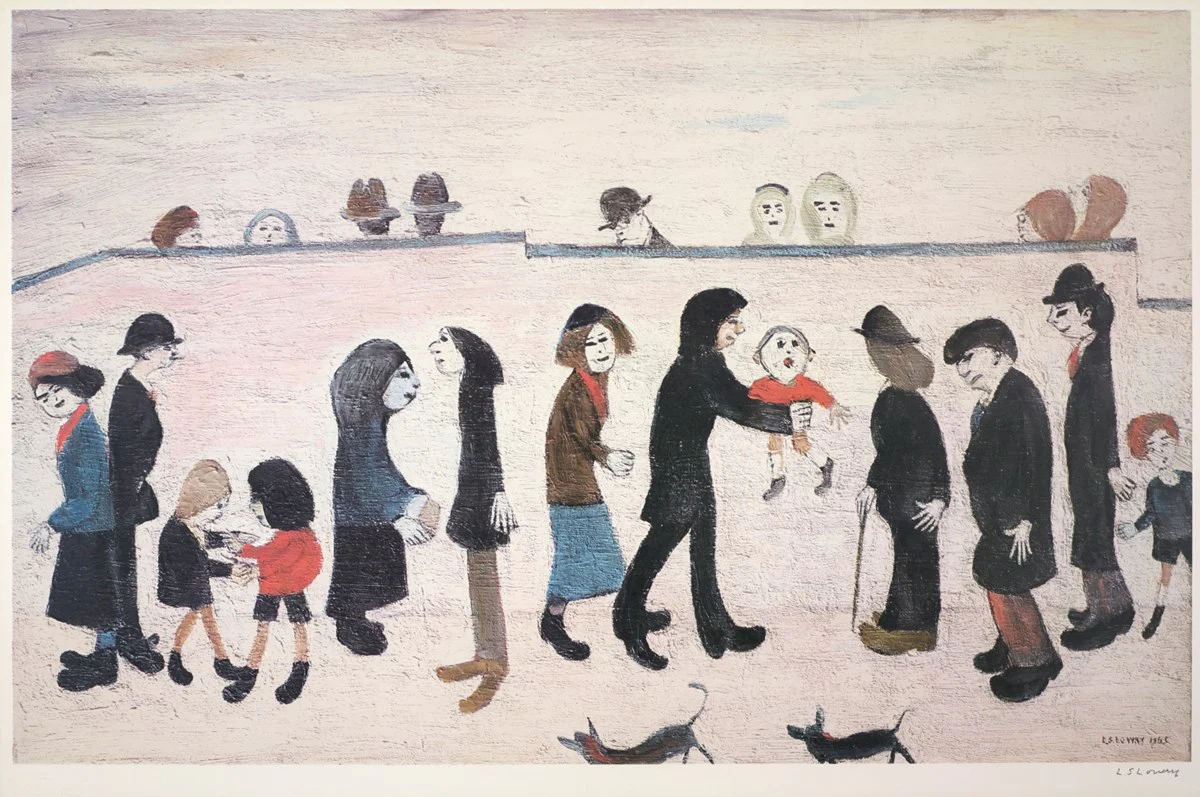
The present work depicts a busy scene, the focal point of which is centred on a man carrying a wailing baby in a red shirt. Lowry employs his characteristic use of red highlights to guide the viewer’s gaze around the painting, drawing out his uncanny ability to breathe life and interest into the everyday. The longer one looks, the more charming details emerge: the two children on the left playing pat-a-cake; the playful dogs in the foreground; the inquisitive man peering over the wall in his bowler hat. Yet, as is often the case with Lowry's compositions, this movement around composition leads the viewer to one particular point. In this instance, the baby of the title.
Although it is the sweeping industrial panoramas that Lowry was best-known for, he moved away from this subject-matter in the late 1940s and 1950s, and began focussing on those individuals that populated his urban landscapes. From the outset of his career, it was the combination of place and people that gave his paintings life, and thus the specific places where people gathered – the courts, alleys and street corners – became the core of Lowry's work. The artist was well aware that his occupation as a rent-collector allowed him to pass into the poorer districts almost unnoticed, areas in which his presence without such a pretext would have been less than welcome.
Lowry was obsessively drawn to watching people going about their daily business, once remarking: “You see these people in the street... They stand at street corners, and they are staring at something and you wonder what they are thinking when they are staring. Have you ever noticed them?”
Observing a group of people ‘just standing about’, as in the present work, was one of Lowry’s everyday joys. Indeed, as Sir Ian McKellen has so eloquently explained, “until Samuel Beckett wrote Waiting for Godot, nobody seems to have noticed that much of human life is to do with waiting, and until Lowry painted his crowds, no other artist had recorded how people (and animals) look and behave en masse. Each individual is on his/her own journey across the canvas yet leaning to form the crowd with its own collective identity. Once you have seen how Lowry saw us, you cannot ever see or be in a football crowd, nor watch kids playing, workers leaving the factory, queuing, or stopping to chat or hear the fairground barker, without saying, “Lowry! It’s just like a Lowry painting!” Going about our business or pleasure, we are all subjects of his vision.”
Original: $10,722.00
-65%$10,722.00
$3,752.70Man Holding Child 203/350
Laurence Stephen Lowry (1887-1976)
Man Holding Child, 1972
Offset lithograph on wove paper, after the original oil painting from 1946 of the same title (Collection: Private collection)
Signed ‘L.S. Lowry’ lower right in pencil
Stamped by the Fine Art Trade Guild and numbered from the edition of 350
Published by the Adam Collection Ltd.
Printed by Chorley & Pickersgill Ltd.
Size: 18 x 28 in. (47 x 71 cm.)
(Please enquire for availability)
Man Holding Child is exemplary of his fascination with individual characters that inspired one critic to describe him as an entomologist, “stalking human insects with his butterfly net... Lowry has become a collector of people.” Here, Lowry is celebrating the ordinary, creating a cast of individual figures with distinctive characteristics and a timeless appeal.
The present work depicts a busy scene, the focal point of which is centred on a man carrying a wailing baby in a red shirt. Lowry employs his characteristic use of red highlights to guide the viewer’s gaze around the painting, drawing out his uncanny ability to breathe life and interest into the everyday. The longer one looks, the more charming details emerge: the two children on the left playing pat-a-cake; the playful dogs in the foreground; the inquisitive man peering over the wall in his bowler hat. Yet, as is often the case with Lowry's compositions, this movement around composition leads the viewer to one particular point. In this instance, the baby of the title.
Although it is the sweeping industrial panoramas that Lowry was best-known for, he moved away from this subject-matter in the late 1940s and 1950s, and began focussing on those individuals that populated his urban landscapes. From the outset of his career, it was the combination of place and people that gave his paintings life, and thus the specific places where people gathered – the courts, alleys and street corners – became the core of Lowry's work. The artist was well aware that his occupation as a rent-collector allowed him to pass into the poorer districts almost unnoticed, areas in which his presence without such a pretext would have been less than welcome.
Lowry was obsessively drawn to watching people going about their daily business, once remarking: “You see these people in the street... They stand at street corners, and they are staring at something and you wonder what they are thinking when they are staring. Have you ever noticed them?”
Observing a group of people ‘just standing about’, as in the present work, was one of Lowry’s everyday joys. Indeed, as Sir Ian McKellen has so eloquently explained, “until Samuel Beckett wrote Waiting for Godot, nobody seems to have noticed that much of human life is to do with waiting, and until Lowry painted his crowds, no other artist had recorded how people (and animals) look and behave en masse. Each individual is on his/her own journey across the canvas yet leaning to form the crowd with its own collective identity. Once you have seen how Lowry saw us, you cannot ever see or be in a football crowd, nor watch kids playing, workers leaving the factory, queuing, or stopping to chat or hear the fairground barker, without saying, “Lowry! It’s just like a Lowry painting!” Going about our business or pleasure, we are all subjects of his vision.”
Product Information
Product Information
Shipping & Returns
Shipping & Returns
Description
Laurence Stephen Lowry (1887-1976)
Man Holding Child, 1972
Offset lithograph on wove paper, after the original oil painting from 1946 of the same title (Collection: Private collection)
Signed ‘L.S. Lowry’ lower right in pencil
Stamped by the Fine Art Trade Guild and numbered from the edition of 350
Published by the Adam Collection Ltd.
Printed by Chorley & Pickersgill Ltd.
Size: 18 x 28 in. (47 x 71 cm.)
(Please enquire for availability)
Man Holding Child is exemplary of his fascination with individual characters that inspired one critic to describe him as an entomologist, “stalking human insects with his butterfly net... Lowry has become a collector of people.” Here, Lowry is celebrating the ordinary, creating a cast of individual figures with distinctive characteristics and a timeless appeal.
The present work depicts a busy scene, the focal point of which is centred on a man carrying a wailing baby in a red shirt. Lowry employs his characteristic use of red highlights to guide the viewer’s gaze around the painting, drawing out his uncanny ability to breathe life and interest into the everyday. The longer one looks, the more charming details emerge: the two children on the left playing pat-a-cake; the playful dogs in the foreground; the inquisitive man peering over the wall in his bowler hat. Yet, as is often the case with Lowry's compositions, this movement around composition leads the viewer to one particular point. In this instance, the baby of the title.
Although it is the sweeping industrial panoramas that Lowry was best-known for, he moved away from this subject-matter in the late 1940s and 1950s, and began focussing on those individuals that populated his urban landscapes. From the outset of his career, it was the combination of place and people that gave his paintings life, and thus the specific places where people gathered – the courts, alleys and street corners – became the core of Lowry's work. The artist was well aware that his occupation as a rent-collector allowed him to pass into the poorer districts almost unnoticed, areas in which his presence without such a pretext would have been less than welcome.
Lowry was obsessively drawn to watching people going about their daily business, once remarking: “You see these people in the street... They stand at street corners, and they are staring at something and you wonder what they are thinking when they are staring. Have you ever noticed them?”
Observing a group of people ‘just standing about’, as in the present work, was one of Lowry’s everyday joys. Indeed, as Sir Ian McKellen has so eloquently explained, “until Samuel Beckett wrote Waiting for Godot, nobody seems to have noticed that much of human life is to do with waiting, and until Lowry painted his crowds, no other artist had recorded how people (and animals) look and behave en masse. Each individual is on his/her own journey across the canvas yet leaning to form the crowd with its own collective identity. Once you have seen how Lowry saw us, you cannot ever see or be in a football crowd, nor watch kids playing, workers leaving the factory, queuing, or stopping to chat or hear the fairground barker, without saying, “Lowry! It’s just like a Lowry painting!” Going about our business or pleasure, we are all subjects of his vision.”