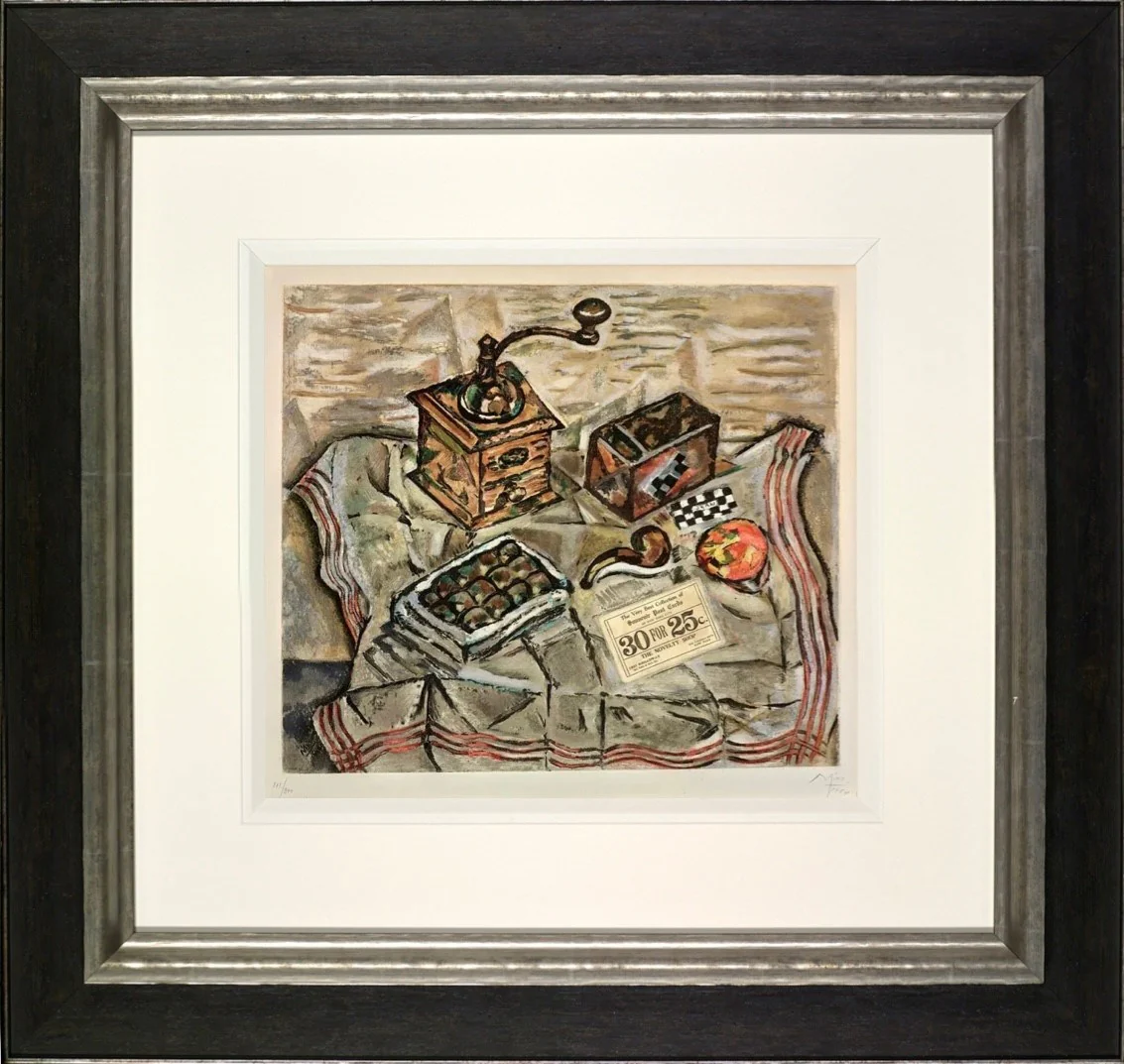

The Harbour 728/850
Laurence Stephen Lowry, R.A. (1887-1976)
The Harbour, 1972
Offset lithograph on wove paper, after the original oil painting from 1957 of the same title (Collection: Private Collection)
Signed ‘L.S. Lowry’ lower right in pencil and numbered from the edition of 850
Stamped by the Fine Art Trade Guild
Published by Venture Prints
Size: 18 x 23 in. (43 x 58 cm.)
(Please enquire for availability)
L.S. Lowry often frequented the Cumbrian coast on account of his friend and fellow artist Sheila Fell who lived in Aspatria, and another friend and collector, the Reverend Geoffrey Bennett, who lived in Maryport. It was in the latter seaside town where the original painting The Harbour was produced, from which this offset lithograph was made. The Cumbrian landscape inspired several of Lowry’s works, although, more often than not, it was the small details that caught his eye: a particular architectural landmark or a certain topographical feature. In the present work it is the working boats that form the focus of the scene: the central, jet-black industrial vessel, chugging along with its smoking funnel is central to the composition, its chimney echoed in the distant, shadowy smokestacks of the town.
Rather than portraying the leisurely pursuits of the town, such the joys of the seafront adorned with yachts as he would do in later works, Lowry instead depicted the harbour as an extension of the town’s industrial heritage. This is not by any means surprising, as Lowry was rarely interested in conventional beauty, and was far more drawn to the gritty realities of life in the Northern towns and cities he knew so well. The subject-matter of the sea, shore, and boats were of particular significance to Lowry, however, as he had spent family holidays at Rhyl, Lytham St. Anne’s, or the Fydle Coast in his youth, and he recalled drawing boats and ships from the age of 8.
The original painting of The Harbour was painted in 1957 when Lowry was 70, the same year he received a letter from a young art student, Carol Ann Lowry (no relation to the artist) which would change her life forever and provide him with one of his most important muses. He initially didn’t reply to Carol’s letter but months later, feeling lonely, he read it again and on impulse jumped on a bus, turning up unannounced on her doorstep in Heywood, Lancashire. When Lowry died in 1976, he bequeathed the entirety of his estate to Carol Ann, having spent the last 20 years tutoring her and developing a friendship so strong he was referred to as “Uncle Laurie”.
Original: $10,722.00
-65%$10,722.00
$3,752.70The Harbour 728/850
Laurence Stephen Lowry, R.A. (1887-1976)
The Harbour, 1972
Offset lithograph on wove paper, after the original oil painting from 1957 of the same title (Collection: Private Collection)
Signed ‘L.S. Lowry’ lower right in pencil and numbered from the edition of 850
Stamped by the Fine Art Trade Guild
Published by Venture Prints
Size: 18 x 23 in. (43 x 58 cm.)
(Please enquire for availability)
L.S. Lowry often frequented the Cumbrian coast on account of his friend and fellow artist Sheila Fell who lived in Aspatria, and another friend and collector, the Reverend Geoffrey Bennett, who lived in Maryport. It was in the latter seaside town where the original painting The Harbour was produced, from which this offset lithograph was made. The Cumbrian landscape inspired several of Lowry’s works, although, more often than not, it was the small details that caught his eye: a particular architectural landmark or a certain topographical feature. In the present work it is the working boats that form the focus of the scene: the central, jet-black industrial vessel, chugging along with its smoking funnel is central to the composition, its chimney echoed in the distant, shadowy smokestacks of the town.
Rather than portraying the leisurely pursuits of the town, such the joys of the seafront adorned with yachts as he would do in later works, Lowry instead depicted the harbour as an extension of the town’s industrial heritage. This is not by any means surprising, as Lowry was rarely interested in conventional beauty, and was far more drawn to the gritty realities of life in the Northern towns and cities he knew so well. The subject-matter of the sea, shore, and boats were of particular significance to Lowry, however, as he had spent family holidays at Rhyl, Lytham St. Anne’s, or the Fydle Coast in his youth, and he recalled drawing boats and ships from the age of 8.
The original painting of The Harbour was painted in 1957 when Lowry was 70, the same year he received a letter from a young art student, Carol Ann Lowry (no relation to the artist) which would change her life forever and provide him with one of his most important muses. He initially didn’t reply to Carol’s letter but months later, feeling lonely, he read it again and on impulse jumped on a bus, turning up unannounced on her doorstep in Heywood, Lancashire. When Lowry died in 1976, he bequeathed the entirety of his estate to Carol Ann, having spent the last 20 years tutoring her and developing a friendship so strong he was referred to as “Uncle Laurie”.
Product Information
Product Information
Shipping & Returns
Shipping & Returns
Description
Laurence Stephen Lowry, R.A. (1887-1976)
The Harbour, 1972
Offset lithograph on wove paper, after the original oil painting from 1957 of the same title (Collection: Private Collection)
Signed ‘L.S. Lowry’ lower right in pencil and numbered from the edition of 850
Stamped by the Fine Art Trade Guild
Published by Venture Prints
Size: 18 x 23 in. (43 x 58 cm.)
(Please enquire for availability)
L.S. Lowry often frequented the Cumbrian coast on account of his friend and fellow artist Sheila Fell who lived in Aspatria, and another friend and collector, the Reverend Geoffrey Bennett, who lived in Maryport. It was in the latter seaside town where the original painting The Harbour was produced, from which this offset lithograph was made. The Cumbrian landscape inspired several of Lowry’s works, although, more often than not, it was the small details that caught his eye: a particular architectural landmark or a certain topographical feature. In the present work it is the working boats that form the focus of the scene: the central, jet-black industrial vessel, chugging along with its smoking funnel is central to the composition, its chimney echoed in the distant, shadowy smokestacks of the town.
Rather than portraying the leisurely pursuits of the town, such the joys of the seafront adorned with yachts as he would do in later works, Lowry instead depicted the harbour as an extension of the town’s industrial heritage. This is not by any means surprising, as Lowry was rarely interested in conventional beauty, and was far more drawn to the gritty realities of life in the Northern towns and cities he knew so well. The subject-matter of the sea, shore, and boats were of particular significance to Lowry, however, as he had spent family holidays at Rhyl, Lytham St. Anne’s, or the Fydle Coast in his youth, and he recalled drawing boats and ships from the age of 8.
The original painting of The Harbour was painted in 1957 when Lowry was 70, the same year he received a letter from a young art student, Carol Ann Lowry (no relation to the artist) which would change her life forever and provide him with one of his most important muses. He initially didn’t reply to Carol’s letter but months later, feeling lonely, he read it again and on impulse jumped on a bus, turning up unannounced on her doorstep in Heywood, Lancashire. When Lowry died in 1976, he bequeathed the entirety of his estate to Carol Ann, having spent the last 20 years tutoring her and developing a friendship so strong he was referred to as “Uncle Laurie”.