The Lonely House
Laurence Stephen Lowry, R.A. (1887-1976)
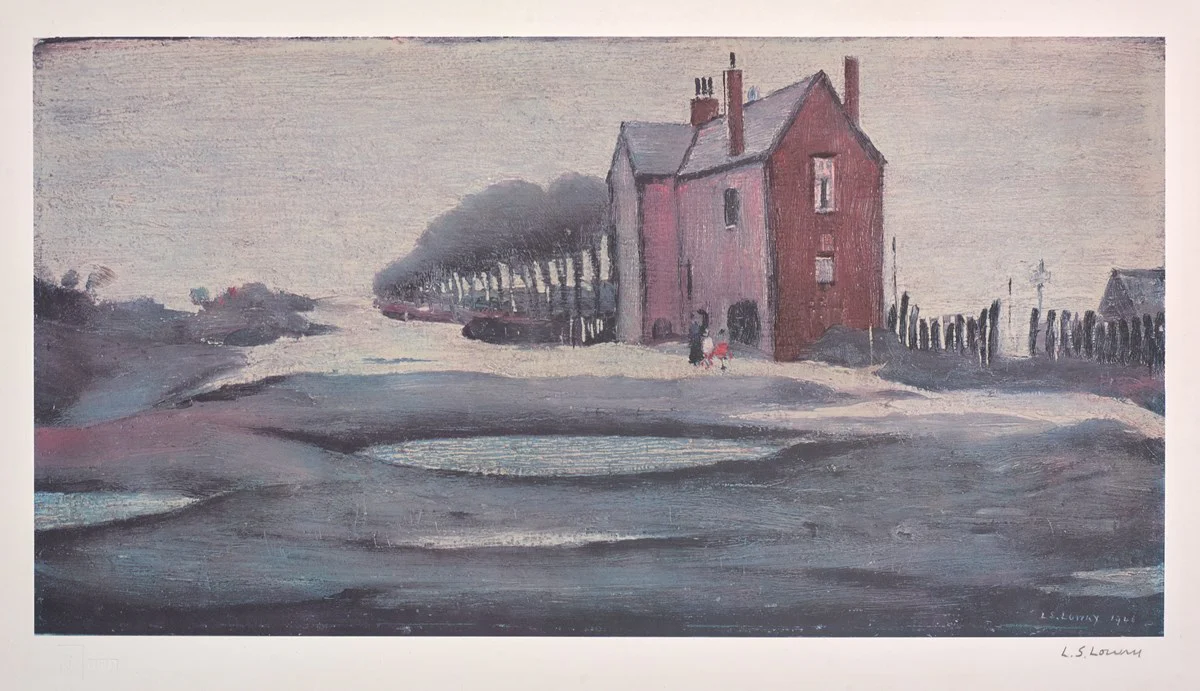
The Lonely House, c. 1973-5
Offset lithograph on wove paper, after the original oil painting from 1946 of the same title (Collection: Private Collection)
Signed ‘L.S. Lowry’ lower right in pencil and numbered from the edition of 500
Stamped by the Fine Art Trade Guild
Published by Magnus Prints
Printed by Hind, Hoyle and Light Ltd., Manchester
Size: 11 x 20 in. (29 x 51 cm.)
(Please enquire for availability)
Dereliction, abandonment, and isolation are three common themes that can be traced throughout Lowry’s oeuvre. Yet these themes appear much more overtly in his earlier work in the 1930s and 40s, most pertinently during the period when Lowry’s relationship with his mother was becoming increasingly fraught as her health was sinking fast, and in the aftermath of her eventual death. Whilst the temptation to read an artist’s mood into their artwork is not always encouraged, in the case of Lowry’s multiple scenes of lonely, empty houses, as in the present work, the buildings take on a particularly strong emotional pull. Questioned on the subject of the empty houses, Lowry once remarked: “They are symbols of myself. They are symbols of my mood.” In stark contrast to his often heavily populated street and industrial scenes, only three figures occupy this composition.
The original painting of The Lonely House was based on a preliminary sketch created over twenty years earlier in 1926, titled House on Botany, Clifton, which resides in The Lowry museum in, Salford.
The original painting, until very recently, was held in the personal collection Dame Kathleen Ollerenshaw, a mathematician and politician who was Lord Mayor of Manchester from 1975 to 1976. She met Lowry at a dinner in 1967, where she mentioned she had bought The Lonely House. Lowry responded by drawing a little sketch of the painting on her napkin.
Today, Lowry’s artwork is perhaps more relevant than ever. His most explored central themes of industrialisation, isolation, and loneliness have a new significance to current society struggling with the uncertainty of a global pandemic and a new social reality.
Original: $9,373.32
-65%$9,373.32
$3,280.66The Lonely House
Laurence Stephen Lowry, R.A. (1887-1976)
The Lonely House, c. 1973-5
Offset lithograph on wove paper, after the original oil painting from 1946 of the same title (Collection: Private Collection)
Signed ‘L.S. Lowry’ lower right in pencil and numbered from the edition of 500
Stamped by the Fine Art Trade Guild
Published by Magnus Prints
Printed by Hind, Hoyle and Light Ltd., Manchester
Size: 11 x 20 in. (29 x 51 cm.)
(Please enquire for availability)
Dereliction, abandonment, and isolation are three common themes that can be traced throughout Lowry’s oeuvre. Yet these themes appear much more overtly in his earlier work in the 1930s and 40s, most pertinently during the period when Lowry’s relationship with his mother was becoming increasingly fraught as her health was sinking fast, and in the aftermath of her eventual death. Whilst the temptation to read an artist’s mood into their artwork is not always encouraged, in the case of Lowry’s multiple scenes of lonely, empty houses, as in the present work, the buildings take on a particularly strong emotional pull. Questioned on the subject of the empty houses, Lowry once remarked: “They are symbols of myself. They are symbols of my mood.” In stark contrast to his often heavily populated street and industrial scenes, only three figures occupy this composition.
The original painting of The Lonely House was based on a preliminary sketch created over twenty years earlier in 1926, titled House on Botany, Clifton, which resides in The Lowry museum in, Salford.
The original painting, until very recently, was held in the personal collection Dame Kathleen Ollerenshaw, a mathematician and politician who was Lord Mayor of Manchester from 1975 to 1976. She met Lowry at a dinner in 1967, where she mentioned she had bought The Lonely House. Lowry responded by drawing a little sketch of the painting on her napkin.
Today, Lowry’s artwork is perhaps more relevant than ever. His most explored central themes of industrialisation, isolation, and loneliness have a new significance to current society struggling with the uncertainty of a global pandemic and a new social reality.
Product Information
Product Information
Shipping & Returns
Shipping & Returns
Description
Laurence Stephen Lowry, R.A. (1887-1976)
The Lonely House, c. 1973-5
Offset lithograph on wove paper, after the original oil painting from 1946 of the same title (Collection: Private Collection)
Signed ‘L.S. Lowry’ lower right in pencil and numbered from the edition of 500
Stamped by the Fine Art Trade Guild
Published by Magnus Prints
Printed by Hind, Hoyle and Light Ltd., Manchester
Size: 11 x 20 in. (29 x 51 cm.)
(Please enquire for availability)
Dereliction, abandonment, and isolation are three common themes that can be traced throughout Lowry’s oeuvre. Yet these themes appear much more overtly in his earlier work in the 1930s and 40s, most pertinently during the period when Lowry’s relationship with his mother was becoming increasingly fraught as her health was sinking fast, and in the aftermath of her eventual death. Whilst the temptation to read an artist’s mood into their artwork is not always encouraged, in the case of Lowry’s multiple scenes of lonely, empty houses, as in the present work, the buildings take on a particularly strong emotional pull. Questioned on the subject of the empty houses, Lowry once remarked: “They are symbols of myself. They are symbols of my mood.” In stark contrast to his often heavily populated street and industrial scenes, only three figures occupy this composition.
The original painting of The Lonely House was based on a preliminary sketch created over twenty years earlier in 1926, titled House on Botany, Clifton, which resides in The Lowry museum in, Salford.
The original painting, until very recently, was held in the personal collection Dame Kathleen Ollerenshaw, a mathematician and politician who was Lord Mayor of Manchester from 1975 to 1976. She met Lowry at a dinner in 1967, where she mentioned she had bought The Lonely House. Lowry responded by drawing a little sketch of the painting on her napkin.
Today, Lowry’s artwork is perhaps more relevant than ever. His most explored central themes of industrialisation, isolation, and loneliness have a new significance to current society struggling with the uncertainty of a global pandemic and a new social reality.