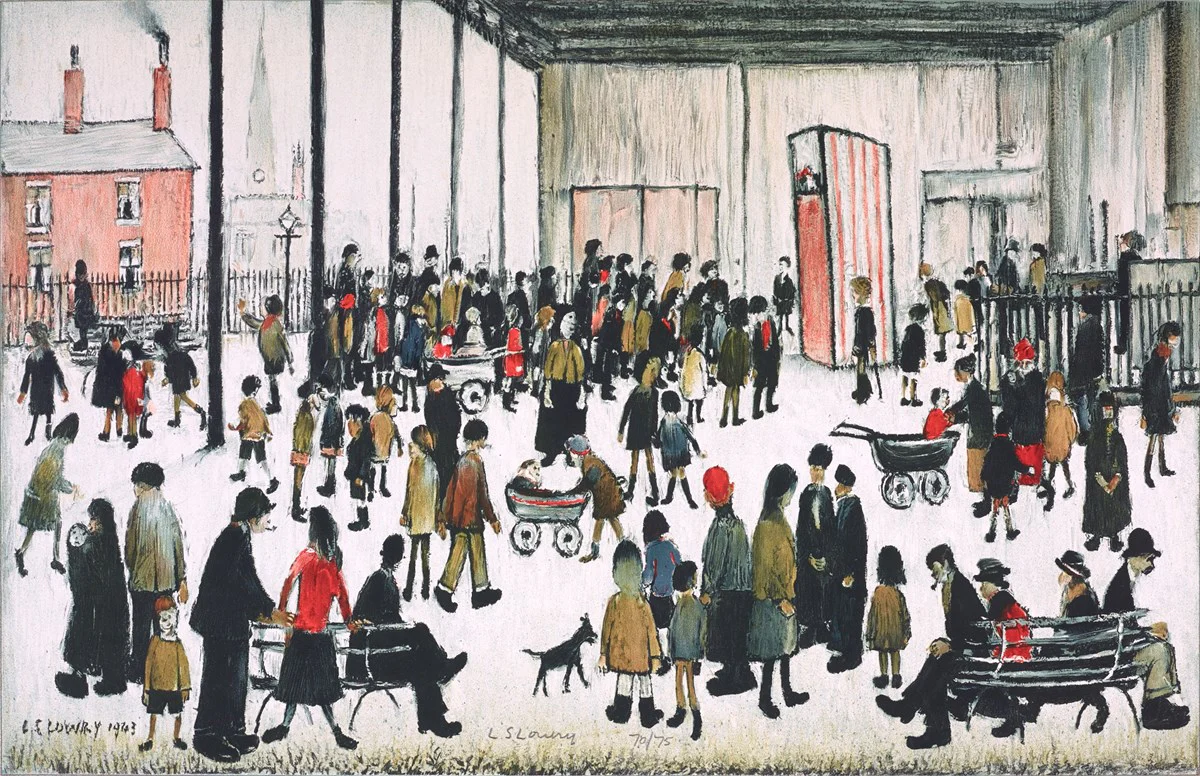

Castle On The Sands 60/75
Laurence Stephen Lowry, R.A. (1887-1976)
Castle on the Sands, 1969-70
Original lithograph in black with tinted ground on wove paper
Signed ‘L.S. Lowry’ lower right and numbered from the edition of 75 lower left in pencil
Printed by Ganymed Press, England
Size: 20 x 25 in. (51 x 63 cm.)
(Please enquire for availability)
Castle on the Sands is a lively example of Lowry’s depictions of the seaside, which varied from the strikingly bleak works, such as The Sea, 1963, to those populated by his matchstick men and filled with humorous caricatures. The present work strikes a balance between the two: there are entertaining details, such as the small child who has joyfully flung his arms and legs into the air as he is pushed, at running pace, by a parental figure; on the other hand, the monochromaticism of the medium, and the typically symmetrical composition, dominated by the dark castle and promenade in the centre, create a pervasive sense of melancholic austerity.
Whilst Lowry occasionally recreated geographic sites exactly, often he composed his works with an amalgamation of invention, memory, and reference to the multitude of pencil sketches that he made whenever he saw anything that struck him as remarkable. Castle on the Sands is very much an example of the latter – a composite work reflective of the seaside in Northern England, as opposed to a specific beach. One wonders whether the castle was plucked entirely from his imagination, or whether it was a familiar historic site... it’s undoubtedly ambiguous, appearing neither to be made of sand nor an actual architectural structure.
More Images

Castle On The Sands 60/75
Laurence Stephen Lowry, R.A. (1887-1976)
Castle on the Sands, 1969-70
Original lithograph in black with tinted ground on wove paper
Signed ‘L.S. Lowry’ lower right and numbered from the edition of 75 lower left in pencil
Printed by Ganymed Press, England
Size: 20 x 25 in. (51 x 63 cm.)
(Please enquire for availability)
Castle on the Sands is a lively example of Lowry’s depictions of the seaside, which varied from the strikingly bleak works, such as The Sea, 1963, to those populated by his matchstick men and filled with humorous caricatures. The present work strikes a balance between the two: there are entertaining details, such as the small child who has joyfully flung his arms and legs into the air as he is pushed, at running pace, by a parental figure; on the other hand, the monochromaticism of the medium, and the typically symmetrical composition, dominated by the dark castle and promenade in the centre, create a pervasive sense of melancholic austerity.
Whilst Lowry occasionally recreated geographic sites exactly, often he composed his works with an amalgamation of invention, memory, and reference to the multitude of pencil sketches that he made whenever he saw anything that struck him as remarkable. Castle on the Sands is very much an example of the latter – a composite work reflective of the seaside in Northern England, as opposed to a specific beach. One wonders whether the castle was plucked entirely from his imagination, or whether it was a familiar historic site... it’s undoubtedly ambiguous, appearing neither to be made of sand nor an actual architectural structure.
Product Information
Product Information
Shipping & Returns
Shipping & Returns
Description
Laurence Stephen Lowry, R.A. (1887-1976)
Castle on the Sands, 1969-70
Original lithograph in black with tinted ground on wove paper
Signed ‘L.S. Lowry’ lower right and numbered from the edition of 75 lower left in pencil
Printed by Ganymed Press, England
Size: 20 x 25 in. (51 x 63 cm.)
(Please enquire for availability)
Castle on the Sands is a lively example of Lowry’s depictions of the seaside, which varied from the strikingly bleak works, such as The Sea, 1963, to those populated by his matchstick men and filled with humorous caricatures. The present work strikes a balance between the two: there are entertaining details, such as the small child who has joyfully flung his arms and legs into the air as he is pushed, at running pace, by a parental figure; on the other hand, the monochromaticism of the medium, and the typically symmetrical composition, dominated by the dark castle and promenade in the centre, create a pervasive sense of melancholic austerity.
Whilst Lowry occasionally recreated geographic sites exactly, often he composed his works with an amalgamation of invention, memory, and reference to the multitude of pencil sketches that he made whenever he saw anything that struck him as remarkable. Castle on the Sands is very much an example of the latter – a composite work reflective of the seaside in Northern England, as opposed to a specific beach. One wonders whether the castle was plucked entirely from his imagination, or whether it was a familiar historic site... it’s undoubtedly ambiguous, appearing neither to be made of sand nor an actual architectural structure.