Punch And Judy 70/75
Laurence Stephen Lowry, R.A. (1887-1976)
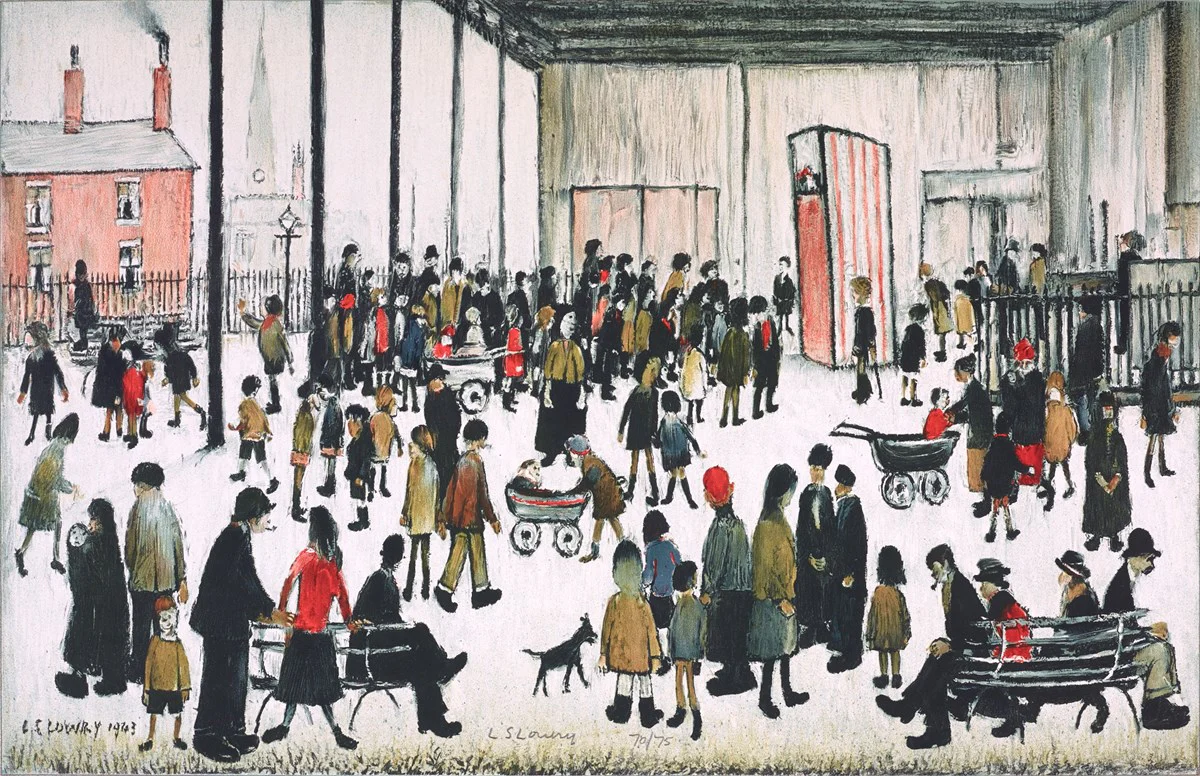
Punch and Judy, 1972
Offset lithograph on wove paper, after the original oil painting from 1943 of the same title (Collection: Private Collection)
Signed ‘L.S. Lowry’ and numbered from the edition of 75 centre in pencil
Published by School Prints Ltd.
Size: 19½ x 30 in. (49.5 x 76 cm.)
(Please enquire for availability)
The present work is an offset lithograph produced by British artist L.S. Lowry, based on the original oil painting of 1943.
Lowry held the belief that art held an important role in a child’s education, and it was with this in mind that he agreed to take part in the ‘School Prints’ scheme, initiated by arts campaigner Ms. Brenda Rawnsley (1916-2007). Before his early death in 1943, Rawnsley’s husband had established two art hiring companies, one allowing people to hire original art for their homes, and the other offering secondary schools the opportunity to rent lithographs and reproductions. The widowed Rawnsley then took over these companies and with the advice from renowned art critic Herbert Read she decided to expand to allow primary schools the chance to rent works as well. In 1946, Ms Rawnsley sent letters to several British artists working at the time, reading; “We are producing a series of auto-lithographs … for use in schools, as a means of giving school children an understanding of contemporary art. By keeping the price as low as possible, we are able to bring this scheme … within reach of all Education Authorities.”
All the lithographs produced for the ‘School Prints’ series had a drawn frame so that the print could be pinned to the wall and could easily be displayed in the classroom. Other artists involved included John Nash, Barbara Jones, and John Tunnard, and many of the prints depict scenes of everyday rural or urban life. The scheme was a unique attempt at giving children access to original works of art in a period of war-time austerity, but sadly ended in 1949 because of financial issues.
Lowry selected Punch and Judy, an oil painting he had produced earlier in 1943. It was made into 6000 prints, each available at a price of around £3 each – affordable enough for schools to purchase the works and display them in classrooms and communal spaces. Only 75 were signed and numbered. Remembered fondly by most adults today from their childhood, Punch and Judy puppet shows were especially popular at busy seaside holiday destinations throughout Britain during the first half of the 20th Century – it is highly likely that Lowry saw his first Punch and Judy show whilst holidaying with his parents at Lytham St Anne’s, on the Fylde coast.
Instead of focusing on the puppet show itself, Lowry chose to position this scene in the background. In true Lowry fashion, the work is centred around a crowd of people. Lowry was an avid people watcher, finding the everyday behaviour of strangers utterly fascinating. One can imagine that while most people were watching the Punch and Judy show, Lowry was watching them with the same intrigue and interest.
Original: $22,860.11
-65%$22,860.11
$8,001.04Punch And Judy 70/75
Laurence Stephen Lowry, R.A. (1887-1976)
Punch and Judy, 1972
Offset lithograph on wove paper, after the original oil painting from 1943 of the same title (Collection: Private Collection)
Signed ‘L.S. Lowry’ and numbered from the edition of 75 centre in pencil
Published by School Prints Ltd.
Size: 19½ x 30 in. (49.5 x 76 cm.)
(Please enquire for availability)
The present work is an offset lithograph produced by British artist L.S. Lowry, based on the original oil painting of 1943.
Lowry held the belief that art held an important role in a child’s education, and it was with this in mind that he agreed to take part in the ‘School Prints’ scheme, initiated by arts campaigner Ms. Brenda Rawnsley (1916-2007). Before his early death in 1943, Rawnsley’s husband had established two art hiring companies, one allowing people to hire original art for their homes, and the other offering secondary schools the opportunity to rent lithographs and reproductions. The widowed Rawnsley then took over these companies and with the advice from renowned art critic Herbert Read she decided to expand to allow primary schools the chance to rent works as well. In 1946, Ms Rawnsley sent letters to several British artists working at the time, reading; “We are producing a series of auto-lithographs … for use in schools, as a means of giving school children an understanding of contemporary art. By keeping the price as low as possible, we are able to bring this scheme … within reach of all Education Authorities.”
All the lithographs produced for the ‘School Prints’ series had a drawn frame so that the print could be pinned to the wall and could easily be displayed in the classroom. Other artists involved included John Nash, Barbara Jones, and John Tunnard, and many of the prints depict scenes of everyday rural or urban life. The scheme was a unique attempt at giving children access to original works of art in a period of war-time austerity, but sadly ended in 1949 because of financial issues.
Lowry selected Punch and Judy, an oil painting he had produced earlier in 1943. It was made into 6000 prints, each available at a price of around £3 each – affordable enough for schools to purchase the works and display them in classrooms and communal spaces. Only 75 were signed and numbered. Remembered fondly by most adults today from their childhood, Punch and Judy puppet shows were especially popular at busy seaside holiday destinations throughout Britain during the first half of the 20th Century – it is highly likely that Lowry saw his first Punch and Judy show whilst holidaying with his parents at Lytham St Anne’s, on the Fylde coast.
Instead of focusing on the puppet show itself, Lowry chose to position this scene in the background. In true Lowry fashion, the work is centred around a crowd of people. Lowry was an avid people watcher, finding the everyday behaviour of strangers utterly fascinating. One can imagine that while most people were watching the Punch and Judy show, Lowry was watching them with the same intrigue and interest.
Product Information
Product Information
Shipping & Returns
Shipping & Returns
Description
Laurence Stephen Lowry, R.A. (1887-1976)
Punch and Judy, 1972
Offset lithograph on wove paper, after the original oil painting from 1943 of the same title (Collection: Private Collection)
Signed ‘L.S. Lowry’ and numbered from the edition of 75 centre in pencil
Published by School Prints Ltd.
Size: 19½ x 30 in. (49.5 x 76 cm.)
(Please enquire for availability)
The present work is an offset lithograph produced by British artist L.S. Lowry, based on the original oil painting of 1943.
Lowry held the belief that art held an important role in a child’s education, and it was with this in mind that he agreed to take part in the ‘School Prints’ scheme, initiated by arts campaigner Ms. Brenda Rawnsley (1916-2007). Before his early death in 1943, Rawnsley’s husband had established two art hiring companies, one allowing people to hire original art for their homes, and the other offering secondary schools the opportunity to rent lithographs and reproductions. The widowed Rawnsley then took over these companies and with the advice from renowned art critic Herbert Read she decided to expand to allow primary schools the chance to rent works as well. In 1946, Ms Rawnsley sent letters to several British artists working at the time, reading; “We are producing a series of auto-lithographs … for use in schools, as a means of giving school children an understanding of contemporary art. By keeping the price as low as possible, we are able to bring this scheme … within reach of all Education Authorities.”
All the lithographs produced for the ‘School Prints’ series had a drawn frame so that the print could be pinned to the wall and could easily be displayed in the classroom. Other artists involved included John Nash, Barbara Jones, and John Tunnard, and many of the prints depict scenes of everyday rural or urban life. The scheme was a unique attempt at giving children access to original works of art in a period of war-time austerity, but sadly ended in 1949 because of financial issues.
Lowry selected Punch and Judy, an oil painting he had produced earlier in 1943. It was made into 6000 prints, each available at a price of around £3 each – affordable enough for schools to purchase the works and display them in classrooms and communal spaces. Only 75 were signed and numbered. Remembered fondly by most adults today from their childhood, Punch and Judy puppet shows were especially popular at busy seaside holiday destinations throughout Britain during the first half of the 20th Century – it is highly likely that Lowry saw his first Punch and Judy show whilst holidaying with his parents at Lytham St Anne’s, on the Fylde coast.
Instead of focusing on the puppet show itself, Lowry chose to position this scene in the background. In true Lowry fashion, the work is centred around a crowd of people. Lowry was an avid people watcher, finding the everyday behaviour of strangers utterly fascinating. One can imagine that while most people were watching the Punch and Judy show, Lowry was watching them with the same intrigue and interest.