
Industrial Panorama
Laurence Stephen Lowry, R.A. (1887-1976)
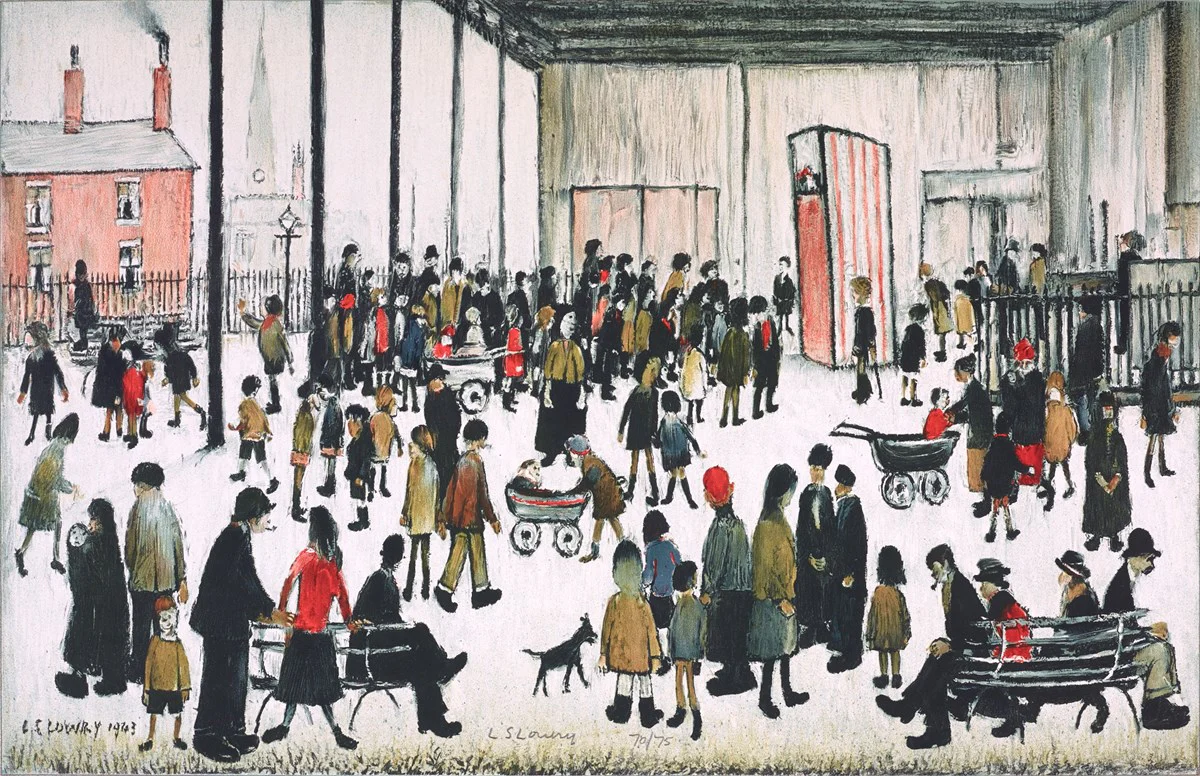
Industrial Panorama, 1972
Offset lithograph on wove paper, after the original oil painting from 1953 of the same title (Collection: Nottingham Castle Museum and Art Gallery, U.K.)
Signed ‘L.S. Lowry’ lower right in pencil
Stamped by the Fine Art Trade Guild and numbered from the edition of 300
Published by the Medici Society Ltd.
Size: 24½ x 32 in. (63.5 x 81 cm.)
(Please enquire for availability)
L.S. Lowry painted Industrial Panorama after an invitation from the Festival of Britain in 1951 to depict a subject of his choice. Only the work’s size was specified: five feet by almost four feet. The resulting picture, Industrial Landscape: River scene, inspired a number of subsequent works, all landscapes filled with familiar motifs, including Industrial Panorama which was published as a print by the Medici Society in 1972. The painting is almost an invitation to join the figures in the foreground and say farewell to a period of thriving British industry that was nearing an end. The year this work was painted, Lowry was also one of a number of artists commissioned by the Ministry of works to record the Coronation of Queen Elizabeth II.
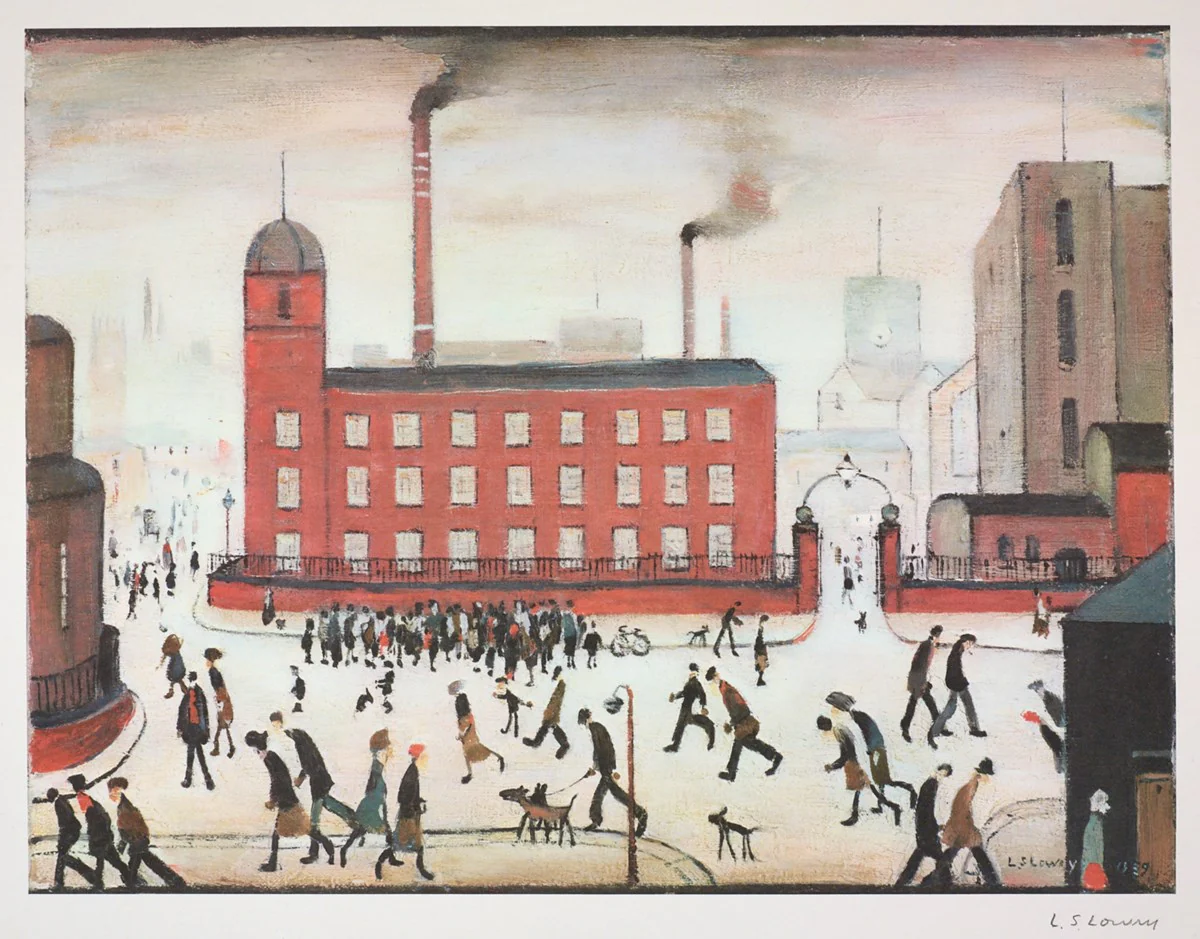
This work is an imaginary, composite scene which depicts a non-specific location, and therefore acts as a symbol of the industrial North of England in its entirety, rather than a singular town. Many English towns in Lowry’s native region of the Northwest during this era evoked a similar attitude due to their collective connections to the milling industry.
“My ambition” Lowry once remarked “was to put the industrial scene on the map, because nobody had done it, nobody had done it seriously.” Lowry’s fascination with the industrial landscape is what makes him unique, something that the great critic Herbert Read found “quite extraordinary… [that] in an industrial country like this, no-one…no painter of any significance has ever taken the industrial landscape as a subject, and what you might call industrial art doesn’t exist.” For Read this is precisely what makes Lowry entirely ‘original’ as an artist.
Original: $20,162.75
-65%$20,162.75
$7,056.96Industrial Panorama
Laurence Stephen Lowry, R.A. (1887-1976)
Industrial Panorama, 1972
Offset lithograph on wove paper, after the original oil painting from 1953 of the same title (Collection: Nottingham Castle Museum and Art Gallery, U.K.)
Signed ‘L.S. Lowry’ lower right in pencil
Stamped by the Fine Art Trade Guild and numbered from the edition of 300
Published by the Medici Society Ltd.
Size: 24½ x 32 in. (63.5 x 81 cm.)
(Please enquire for availability)
L.S. Lowry painted Industrial Panorama after an invitation from the Festival of Britain in 1951 to depict a subject of his choice. Only the work’s size was specified: five feet by almost four feet. The resulting picture, Industrial Landscape: River scene, inspired a number of subsequent works, all landscapes filled with familiar motifs, including Industrial Panorama which was published as a print by the Medici Society in 1972. The painting is almost an invitation to join the figures in the foreground and say farewell to a period of thriving British industry that was nearing an end. The year this work was painted, Lowry was also one of a number of artists commissioned by the Ministry of works to record the Coronation of Queen Elizabeth II.
This work is an imaginary, composite scene which depicts a non-specific location, and therefore acts as a symbol of the industrial North of England in its entirety, rather than a singular town. Many English towns in Lowry’s native region of the Northwest during this era evoked a similar attitude due to their collective connections to the milling industry.
“My ambition” Lowry once remarked “was to put the industrial scene on the map, because nobody had done it, nobody had done it seriously.” Lowry’s fascination with the industrial landscape is what makes him unique, something that the great critic Herbert Read found “quite extraordinary… [that] in an industrial country like this, no-one…no painter of any significance has ever taken the industrial landscape as a subject, and what you might call industrial art doesn’t exist.” For Read this is precisely what makes Lowry entirely ‘original’ as an artist.
Product Information
Product Information
Shipping & Returns
Shipping & Returns
Description
Laurence Stephen Lowry, R.A. (1887-1976)
Industrial Panorama, 1972
Offset lithograph on wove paper, after the original oil painting from 1953 of the same title (Collection: Nottingham Castle Museum and Art Gallery, U.K.)
Signed ‘L.S. Lowry’ lower right in pencil
Stamped by the Fine Art Trade Guild and numbered from the edition of 300
Published by the Medici Society Ltd.
Size: 24½ x 32 in. (63.5 x 81 cm.)
(Please enquire for availability)
L.S. Lowry painted Industrial Panorama after an invitation from the Festival of Britain in 1951 to depict a subject of his choice. Only the work’s size was specified: five feet by almost four feet. The resulting picture, Industrial Landscape: River scene, inspired a number of subsequent works, all landscapes filled with familiar motifs, including Industrial Panorama which was published as a print by the Medici Society in 1972. The painting is almost an invitation to join the figures in the foreground and say farewell to a period of thriving British industry that was nearing an end. The year this work was painted, Lowry was also one of a number of artists commissioned by the Ministry of works to record the Coronation of Queen Elizabeth II.
This work is an imaginary, composite scene which depicts a non-specific location, and therefore acts as a symbol of the industrial North of England in its entirety, rather than a singular town. Many English towns in Lowry’s native region of the Northwest during this era evoked a similar attitude due to their collective connections to the milling industry.
“My ambition” Lowry once remarked “was to put the industrial scene on the map, because nobody had done it, nobody had done it seriously.” Lowry’s fascination with the industrial landscape is what makes him unique, something that the great critic Herbert Read found “quite extraordinary… [that] in an industrial country like this, no-one…no painter of any significance has ever taken the industrial landscape as a subject, and what you might call industrial art doesn’t exist.” For Read this is precisely what makes Lowry entirely ‘original’ as an artist.