St Simon's Church 181/300
Laurence Stephen Lowry, R.A. (1887-1976)
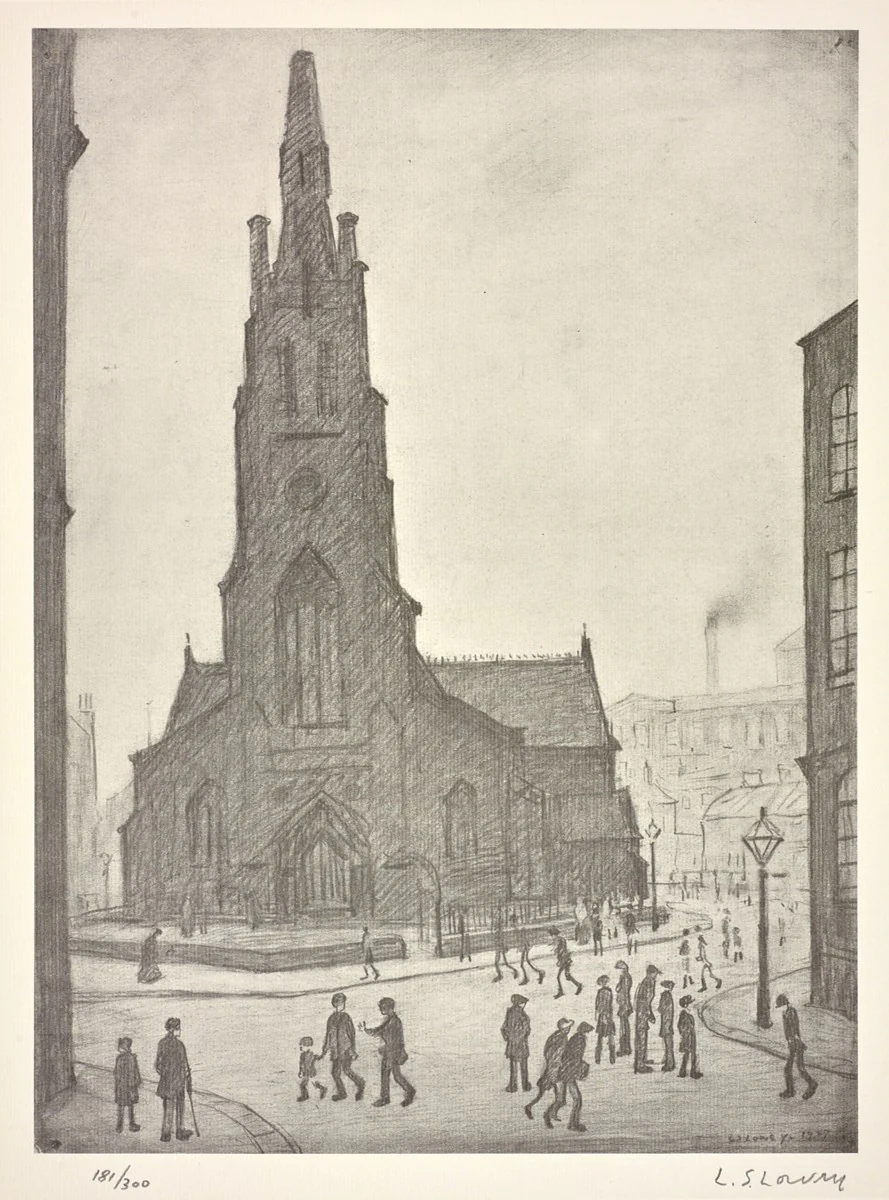
St Simon’s Church, 1972
Offset lithograph on wove paper, after the original pencil drawing from 1927 produced for the oil painting, A Street Scene (St Simon’s Church), 1928 (Collection: The Lowry, Salford)
Signed ‘L.S. Lowry’ lower right and numbered from the edition of 300 lower left in pencil
Published by Grove Galleries
Size: 14½ x 11 in. (37 x 28 cm.)
(Please enquire for availability)
Ecclesiastical buildings are a common feature in L.S. Lowry’s work, their Gothic steeples often punctuating the brooding skylines of his celebrated cityscapes. Often invented, Lowry’s use of church architecture was as much a compositional technique as it was a means of recreating the feel of Northern towns and cities.
Lowry’s relationship with his father, Robert, was never particularly affectionate, with Lowry once describing him a ‘cold fish’, mired in disappointment for his failure to fulfil either his wife’s expectations of him or his own. However, the present work, St Simon’s Church, was executed following a heartfelt moment between the two: Lowry’s father warned him that the Salford Church was about to be demolished, and the artist swiftly produced a loose preliminary sketch on the back of an envelope to preserve the architecture in his memory. The sketch would form the basis of his more finished drawing of the same subject, of which the present work is a lithograph after. By the time Lowry had completed his drawing of St. Simon’s, the demolition of the church had been completed. He therefore only had his own sketches at his disposal from which to create the original oil painting A Street Scene (St Simon’s Church).
The present work is unusual as it forms an accurate rendering of a topographical landmark, rather than an imaginary or composite scene with invented features, as was so often the case with his work. Destroyed in 1927, the memory of St. Simon’s remains forever crystallised in Lowry’s loving depiction of a familiar site in his beloved Salford.
St Simon's Church 181/300
Laurence Stephen Lowry, R.A. (1887-1976)
St Simon’s Church, 1972
Offset lithograph on wove paper, after the original pencil drawing from 1927 produced for the oil painting, A Street Scene (St Simon’s Church), 1928 (Collection: The Lowry, Salford)
Signed ‘L.S. Lowry’ lower right and numbered from the edition of 300 lower left in pencil
Published by Grove Galleries
Size: 14½ x 11 in. (37 x 28 cm.)
(Please enquire for availability)
Ecclesiastical buildings are a common feature in L.S. Lowry’s work, their Gothic steeples often punctuating the brooding skylines of his celebrated cityscapes. Often invented, Lowry’s use of church architecture was as much a compositional technique as it was a means of recreating the feel of Northern towns and cities.
Lowry’s relationship with his father, Robert, was never particularly affectionate, with Lowry once describing him a ‘cold fish’, mired in disappointment for his failure to fulfil either his wife’s expectations of him or his own. However, the present work, St Simon’s Church, was executed following a heartfelt moment between the two: Lowry’s father warned him that the Salford Church was about to be demolished, and the artist swiftly produced a loose preliminary sketch on the back of an envelope to preserve the architecture in his memory. The sketch would form the basis of his more finished drawing of the same subject, of which the present work is a lithograph after. By the time Lowry had completed his drawing of St. Simon’s, the demolition of the church had been completed. He therefore only had his own sketches at his disposal from which to create the original oil painting A Street Scene (St Simon’s Church).
The present work is unusual as it forms an accurate rendering of a topographical landmark, rather than an imaginary or composite scene with invented features, as was so often the case with his work. Destroyed in 1927, the memory of St. Simon’s remains forever crystallised in Lowry’s loving depiction of a familiar site in his beloved Salford.
Product Information
Product Information
Shipping & Returns
Shipping & Returns
Description
Laurence Stephen Lowry, R.A. (1887-1976)
St Simon’s Church, 1972
Offset lithograph on wove paper, after the original pencil drawing from 1927 produced for the oil painting, A Street Scene (St Simon’s Church), 1928 (Collection: The Lowry, Salford)
Signed ‘L.S. Lowry’ lower right and numbered from the edition of 300 lower left in pencil
Published by Grove Galleries
Size: 14½ x 11 in. (37 x 28 cm.)
(Please enquire for availability)
Ecclesiastical buildings are a common feature in L.S. Lowry’s work, their Gothic steeples often punctuating the brooding skylines of his celebrated cityscapes. Often invented, Lowry’s use of church architecture was as much a compositional technique as it was a means of recreating the feel of Northern towns and cities.
Lowry’s relationship with his father, Robert, was never particularly affectionate, with Lowry once describing him a ‘cold fish’, mired in disappointment for his failure to fulfil either his wife’s expectations of him or his own. However, the present work, St Simon’s Church, was executed following a heartfelt moment between the two: Lowry’s father warned him that the Salford Church was about to be demolished, and the artist swiftly produced a loose preliminary sketch on the back of an envelope to preserve the architecture in his memory. The sketch would form the basis of his more finished drawing of the same subject, of which the present work is a lithograph after. By the time Lowry had completed his drawing of St. Simon’s, the demolition of the church had been completed. He therefore only had his own sketches at his disposal from which to create the original oil painting A Street Scene (St Simon’s Church).
The present work is unusual as it forms an accurate rendering of a topographical landmark, rather than an imaginary or composite scene with invented features, as was so often the case with his work. Destroyed in 1927, the memory of St. Simon’s remains forever crystallised in Lowry’s loving depiction of a familiar site in his beloved Salford.